Skip to content
Toggle main navigation
Riverscapes Consortium logo
  • Home
  • About
    • Discover
    • Models
    • Applications
    • Data Exchange
  • Communities
  • Opportunities
  • Events
  • Resources
    • Learn Riverscapes Studio (QRiS)
    • Low-Tech Process Based Restoration
    • Wildfire + Riverscapes
    • News
    • Support
    Log in
    Select an available language
    EN

    News

    All
    Apps
    Datasets
    Policy
    Publications
    Restoration, Management
    Riverscape Health

    Highlighted News

    Results (10)

    Advanced LTPBR Courses Return This Fall

    Advanced LTPBR Courses Return This Fall

    Advance Your Riverscape Restoration Skills This FallLive online courses in LTPBR planning, design, monitoring, and prioritization Our popular lineup of advanced riverscapes courses is back this fall. Designed for professionals, practitioners, and students — anyone working to understand, manage, and restore healthy riverscapes.View Courses and Register Low-Tech Process-Based Restoration (LTPBR) of
    August 11, 2026
    Riverscapes Launches PBR Explorer

    Riverscapes Launches PBR Explorer

    Riverscapes Launches PBR ExplorerRiverscapes Consortium is excited to announce the launch of PBR Explorer, replacing the LTPBR Explorer with an upgraded platform to support all stages and all types of process-based restoration projects. PBR Explorer makes it easy to track, map, and share the full scope of your restoration work across teams, organizations, or private or public audiences. Map-integr
    July 22, 2025
    Four New Advanced LTPBR Courses Offered This Fall

    Four New Advanced LTPBR Courses Offered This Fall

    This fall, four weeklong advanced Low-Tech Process-Based Restoration (LTPBR) courses will be offered for the first time, led by Dr. Joe Wheaton and Utah State University. Designed for professionals in riverscape restoration and river restoration, these courses are eligible for continuing education units, graduate-level university credit, and Level III in the Federal training series. Advanced LTPBR
    May 16, 2025
    New Paper on "Beaver Versus Human: The Big Differences in Small Dams" just published in WiRES Water!

    New Paper on "Beaver Versus Human: The Big Differences in Small Dams" just published in WiRES Water!

    Ellen Wohl and Shreeram Inamdar just published a really interesting perspective piece and reivew on the difference between natural beaver dams, beaver dam meadows, man made dams and beaver dam analogues. They lay out some helpful conceptual distincitions between different structural elements with the label of "dam" tied to them.It is worth noting that BDAs without mainteance (by humans) or as inte
    March 27, 2025
    Inviting Abstract Submissions to "Using Geomorphology in River Management: From Science to Management" at 11th IAG in New Zealand!

    Inviting Abstract Submissions to "Using Geomorphology in River Management: From Science to Management" at 11th IAG in New Zealand!

    Dear Colleagues and Friends, We are pleased to inform you that abstract submissions for the session on Using geomorphology in river management: From science to action at the 11th IAG International Conference on Geomorphology are now open. This session will include a Joint keynote address: Professor Kirstie Fryirs and Professor Joe Wheaton - “Same but different: Using generic geomorphic principles
    March 10, 2025
    New Report from Meridian Institute on "Process-Based Riverscape Restoration Education and Training Needs Assessment"

    New Report from Meridian Institute on "Process-Based Riverscape Restoration Education and Training Needs Assessment"

    Check out the Process-Based Riverscape Restoration Education and Training Needs Assessment  based on Meridian's work and hosted workshops on Nature-Based Solutions on Public Lands. Based on input from industry experts and professionals, they synthesize the needs and issues facing the community. Download Report Now
    November 12, 2024
    LTPBR Protocol Version 2 Just Released

    LTPBR Protocol Version 2 Just Released

    CaptionNew Protocol Released Today!Today, the Low-Tech Process-Based Restoration Design and Monitoring Protocol - version 2.0, was published.  This a project-based, flexible and extendible protocol for action-effectiveness monitoring of LTPBR projects.  The protocol lays out the basics for how to do document, quantify, record and analyze  the planning, design, as-builts and evaluation steps of LTP
    September 16, 2024
    H2O'Lyon Webinar, Seminar and Field Series on "HOW CAN BEAVERS HELP RIVER MANAGEMENT AND CLIMATE RESILIENCE?"

    H2O'Lyon Webinar, Seminar and Field Series on "HOW CAN BEAVERS HELP RIVER MANAGEMENT AND CLIMATE RESILIENCE?"

    H20'Lyon recently led a wonderful 3-part seminar on "How can beavers help river managemetn and climate resilience?" The series featured national and international presentations, and field visits, addressed to researchers, managers, naturalists and students. Even if you missed it live, you can still watch the webinar portions!After a long period of decline, beaver populations have been expanding in
    July 19, 2024
    "No Longer Working Against the Stream" Fact Sheets Released by NRDC!

    "No Longer Working Against the Stream" Fact Sheets Released by NRDC!

    Last week, a series of four Fact Sheets on healthy riverscapes were released by NRDC and co-authored with American Rivers and the National Wildlife Federaton. These fact sheets provide tangible policy and management actions that can lead to more resilent and healthy riverscapes in the US. Moreover, they are aligned with the mission and vision of the Riverscapes Consortium. NRDC is pleased to share
    July 3, 2024
    New paper: "From pixels to riverscapes: How remote sensing and geospatial tools can prioritize riverscape restoration at multiple scales"

    New paper: "From pixels to riverscapes: How remote sensing and geospatial tools can prioritize riverscape restoration at multiple scales"

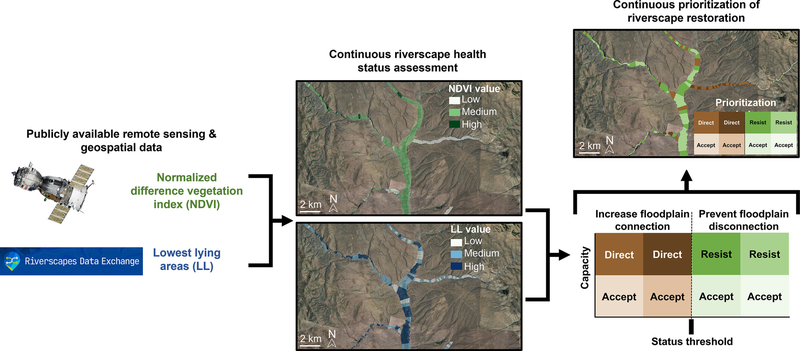
    A new article published last month by Hayley Glassic and colleagues in WIREs Water highlights the use of remote sensing and RC models to inform the prioritization riverscape restoration at multiple scales. The article is open access.Glassic, H. C., McGwire, K. C., Macfarlane, W. W., Rasmussen, C., Bouwes, N., Wheaton, J. M., & Al-Chokhachy, R. (2024). From pixels to riverscapes: How remote sensing
    May 11, 2024
    Contact
    support@riverscapes.freshdesk.com
    Links
    • Data Exchange
    • PBR Explorer
    • About
    • Applications
    • Models
    • Support
    Community engagement platform by Hivebrite.