
Inviting Abstract Submissions to "Using Geomorphology in River Management: From Science to Management" at 11th IAG in New Zealand!
Dear Colleagues and Friends,
We are pleased to inform you that abstract submissions for the session on Using geomorphology in river management: From science to action at the 11th IAG International Conference on Geomorphology are now open.
This session will include a Joint keynote address: Professor Kirstie Fryirs and Professor Joe Wheaton - “Same but different: Using generic geomorphic principles in place-based riverscape management on two continents.”
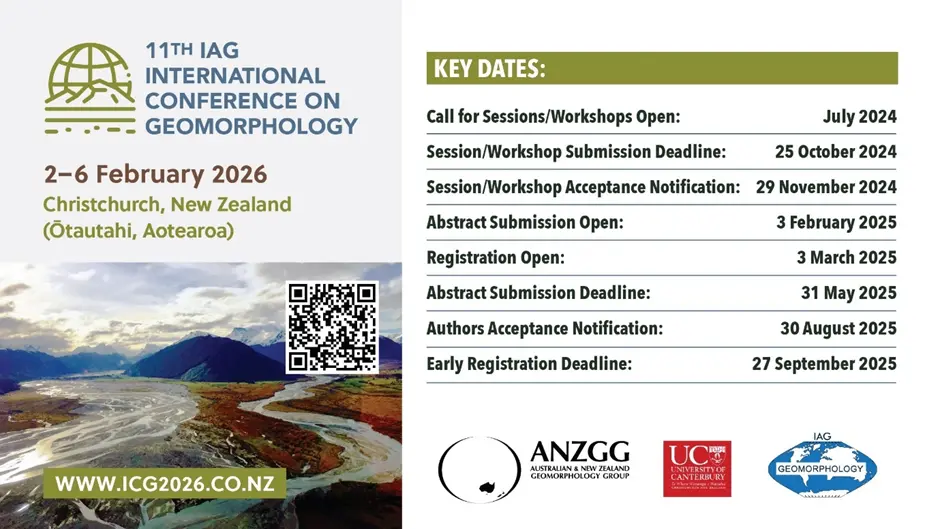
The deadline for submission of abstracts has been set by the organisers for 31 May 2025. Here is the link to the submission page
Here is the link to the session description (scroll down to the bottom)
Why not make an extended holiday of your trip Down Under to New Zealand (and hopefully Australia which is just across ‘The Ditch’). We are a friendly, collegial bunch, and you can come and see some of the amazing fluvial geomorphology and river management that you have been reading about for many years!
We look forward to seeing you in our part of the World.
Kirstie, Jo, Alex, Ben
Using geomorphology in river management: From science to action
Kirstie Fryirs1,5, Jo Hoyle2,6, Alex Sims3,6, Ben Pearson4,5
1Macquarie University, Australia, 2NIWA, New Zealand, 3Alluvium Consulting, Dunedin, New Zealand, 4Hydrobiology, Australia 5River Basin Management Society, Australia 6New Zealand Rivers Group, New Zealand
Joint keynote address: Professor Kirstie Fryirs and Joe Wheaton
“Same but different: Using generic geomorphic principles in place-based riverscape management on two continents.”
Geomorphology provides a critical framework for understanding and managing rivers. Geomorphologists are increasingly required to reconstruct and explain past river behaviour, map and interpret contemporary forms and processes, to make predictions about future river behaviour and to apply these skills to projects aimed at rehabilitating degraded ecosystems, reducing flood hazards, preparing for droughts and climate extremes, and protecting natural and human made assets. The increased use of geomorphology in such projects has been accompanied by a revolution in the tools and methods employed by geomorphologists, enabled by the explosion in the availability and resolution of remote sensing data, dating techniques, repeat high-resolution surveys and increased computing power.
Advances in measurement and modelling methods, and the technology deployed during fieldwork have occurred while the field of applied fluvial geomorphology is increasingly shifting away from the traditional ‘command and control’ paradigm of river management, towards more holistic and process-based modes of thinking. Contemporary river management is increasingly focused on accelerating natural river recovery, using nature-based solutions and prioritising low-cost interventions that work with river processes to shape geomorphic trajectories. When used appropriately these new approaches have the potential to deliver multiple benefits including increased habitat provision, lower overall maintenance costs, decreased natural hazard impacts and carbon sequestration.
This session is co-convened by the Australian River Basin Management Society and The New Zealand Rivers Group. We welcome studies that explore how recent advancements in fluvial geomorphology are being used to drive more sustainable river management practices. We seek contributions that synthesise the many examples of innovative rehabilitation techniques and case studies to identify how actions can be up scaled and implemented. We also welcome studies that provide guidance on how to communicate applied geomorphology in river management practice, and thoughts towards professional development needs and development of communities of practice for applied geomorphologists.